
When Tzedek America educator Randy Fried reflects on the experiences that shaped his work today, he often returns to a moment from childhood. In a recent essay for the Times of Israel, Fried recalls a confrontation on his elementary school playground after a classmate struggled to understand how he could be both Latino and Jewish. The exchange stayed with him long after the near-fight ended. As he writes, “some people genuinely cannot imagine Jews coming in more than one shade.”
For Fried, that early encounter revealed a broader reality: assumptions about Jewish identity are often narrow, leaving little room for the complexity of lived experience. Today, those insights inform his work with Tzedek America, a nonprofit focused on immersive social impact experiences for all ages. Through a project supported by the Jews of Color Initiative’s Addressing Antisemitism Through a JoC Lens cohort, the organization is expanding its interfaith, anti-bias programming for high school students—bringing the perspectives of Jews of Color into conversations about antisemitism and identity.
The project reflects the importance of addressing antisemitism and other forms of bias at a formative moment in the lives of teens. “If we start addressing antisemitism in college…a lot of ideas about identity or someone else’s identity and biased thoughts are already pretty baked in, Fried explains. “In high school, they are still stress-testing and evaluating those ideas. We find high school students are more pliable and open to having these conversations.”
That approach is already reaching a wide audience. Over the past school year, Tzedek America’s programming engaged more than 17,000 students. During this time, Tzedek America has grown their capacity, including hiring a full-time director of in-school programming, enabling them to become a vetted vendor with the Los Angeles Unified School District, one of the largest school districts in the country with 184 high schools. “JoCI’s support has allowed us to create programs where we help communities recognize blind spots so we can make progress,” Fried says.
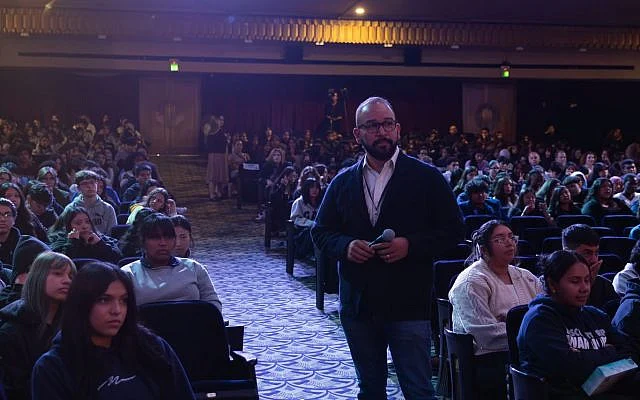
Inside classrooms and student assemblies, the workshops invite teens to examine how bias operates in their everyday environments. Through storytelling, roleplay, and facilitated discussion, students explore how racism, antisemitism, and other forms of hate intersect—and, most importantly, how they can respond. Fried encourages students to think about hate as a widespread, multifaceted issue that demands collective action. As he explains, the goal is helping young people recognize that “we have to find ways of working together to confront hate because it impacts every group.”
Fried’s own story often serves as a bridge in these conversations. “Being a Latino Jew really acts as a bridge for having conversations about that intersection, especially in non-Jewish spaces,” he says.
Last year, Tzedek America created a space specifically for Jewish teens of Color through a Jews of Color Lunch & Learn. Educator Ziggy Valdez facilitated conversations centered on belonging, resilience, and identity. The gatherings brought together students to reflect on their experiences and build community with peers of intersectional Jewish identities.
“Getting the teens to engage with each other about what it means for them to be Jews of Color,” Valdez says, has been one of the most meaningful aspects of my work. “They really got to see themselves and each other more clearly through these conversations.”
The goal, Valdez explains, is to create an environment where young people can embrace their identities fully. “We’re inviting students to be really proud of who they are and show up as themselves fully, and not feel that they have to hide or suppress a part of themselves in order to fit into a group.”
In parallel, Valdez and Fried have an opportunity to engage with their adult peers through JoCI’s Addressing Antisemitism Through a JoC Lens cohort. “It can feel daunting to be doing a project that’s so niche,” Valdez reflects, naming that as a minority within a minority, there is often not enough space devoted to understanding perspectives of Jews of Color. “It’s so powerful for us to get together [with the grantee cohort]… and know these other project leaders are navigating similar things.”
For the Jews of Color Initiative, this work reflects a broader principle: addressing antisemitism effectively requires approaches that acknowledge the multiracial reality of Jewish life and place us in conversation with our communities. The collaborative structure of JoCI’s grantee cohort allows leaders to share insights, test ideas, and support one another as they develop new strategies.
“It’s really amazing to see the work everyone else is doing in the JoC world,” Valdez says. “Solving antisemitism through a JoC lens is not something a single person can do by themselves. It’s powerful to gather together.”
For Fried, the value of the cohort is exemplified by collective learning. “The value is really both from a sense of support—what are the problems that we’re all seeing across the board in our different spaces, and troubleshooting that together,” he explains. “It’s supportive and collaborative… I’m so appreciative of JoCI bringing us together.”
Ultimately, the work underway at Tzedek America reflects a larger shift across the field. Rather than treating antisemitism as an isolated issue, their JoCI-supported programs encourage students to understand how different forms of bias intersect, and how communities can respond together.
As Valdez puts it, this approach grows from the insight that Jews of Color bring a unique vantage point to the work. “Coming from our perspective as JoC, we can do something to stop antisemitism,” they say. “We are building skills and projects that help the entire Jewish community do it in a way that’s different than how it’s been done before.”
Through efforts like these, JoCI’s grantee cohort is helping develop new tools, new leaders, and new pathways for confronting antisemitism.
